
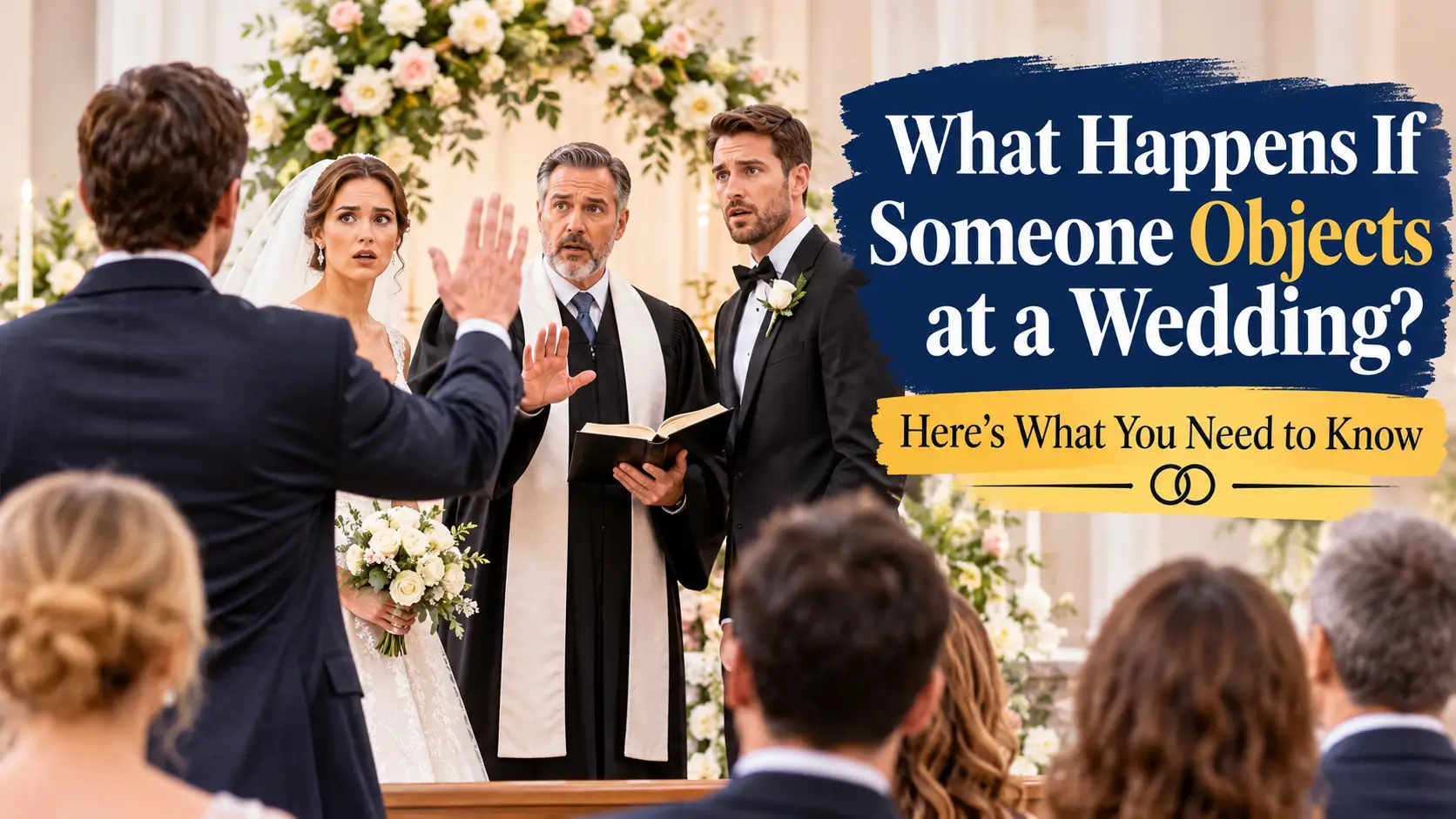
If someone objects at a wedding, the ceremony may pause while the officiant addresses the interruption. However, an objection does not automatically stop the marriage or make it legally invalid in the United States.
The officiant will usually determine whether the person has raised a genuine legal concern or is simply expressing a personal opinion. Most objections do not prevent the wedding from continuing.
The famous phrase, “Speak now or forever hold your peace,” makes wedding objections seem dramatic. Movies often show someone standing up at the last moment to reveal a secret or declare their love for the bride or groom.
In real life, the situation is usually less dramatic. Understanding what an objection actually means can help couples, guests, and wedding officiants know how to respond.
What Does It Mean to Object at a Wedding?
Objecting at a wedding means publicly expressing opposition to a couple getting married during their wedding ceremony.
Traditionally, an officiant invited guests to speak if they knew a legitimate reason the couple should not marry. The question was not intended to give everyone an opportunity to share personal opinions about the relationship.
Historically, an objection could involve concerns such as:
- One person was already legally married to someone else.
- The couple had a prohibited close family relationship.
- One person was being forced into the marriage.
- One or both individuals did not meet the applicable legal requirements to marry.
- There was another recognized legal or religious impediment.
Traditional practice: The objection provided an opportunity to bring important information to light before the marriage ceremony was completed.
Modern practice: Most wedding objections are unexpected interruptions, personal disagreements, or dramatic attempts to get someone’s attention. They rarely involve a genuine legal barrier.
What Happens If Someone Objects at a Wedding Ceremony?
The exact response depends on what the person says, whether the concern is credible, and the type of wedding ceremony.
Here is what commonly happens when someone interrupts a wedding.
1. The Ceremony May Pause
When someone stands up and announces an objection, the officiant will usually stop speaking temporarily.
The couple, wedding party, and guests may turn toward the person. The officiant may ask the individual to explain the reason for the interruption.
For example, someone might say:
“I have something important to tell you before this marriage takes place.”
The officiant may ask whether the concern involves a genuine legal issue or a personal disagreement.
A brief pause gives everyone an opportunity to understand what is happening before the ceremony continues.
2. The Officiant May Ask for an Explanation
Not every objection deserves the same response.
An officiant may ask the person to explain their concern privately rather than allowing an argument to develop in front of the guests.
For example:
- A family member objects because they dislike the bride’s choice of partner.
- A former partner claims the groom is still legally married.
- Someone raises concerns about possible coercion.
- A guest interrupts because they want to confess romantic feelings.
These situations have very different implications.
A personal disagreement does not normally create a legal reason to stop a marriage. However, a credible claim involving an existing marriage, lack of consent, or another legal impediment deserves attention.
3. The Officiant May Continue the Ceremony
If the objection is simply personal, the officiant may decide that there is no reason to delay the wedding.
For example, imagine the bride’s brother stands up and says he does not approve of her future husband.
Although the moment may be uncomfortable, his opinion does not automatically prevent the couple from getting married.
The officiant can ask him to remain quiet or leave if he continues disrupting the ceremony.
If no genuine legal concern exists, the ceremony may continue according to the officiant’s judgment and applicable requirements.
4. The Wedding May Be Delayed
A wedding may be postponed if someone presents credible information suggesting the marriage cannot legally proceed.
For example, imagine a guest tells the officiant that the groom is already legally married to another person.
If the claim appears credible, the officiant should not simply ignore it. The couple may need to clarify their legal status before proceeding.
Other concerns involving consent, legal eligibility, or identity may also require investigation.
The exact requirements depend on state law and the circumstances.
5. The Wedding May Be Stopped
In some circumstances, the officiant may refuse to complete the ceremony.
This can happen when there is a confirmed legal impediment or when the officiant cannot satisfy the applicable requirements for solemnizing the marriage.
For example, if one person is already legally married and the previous marriage has not been legally dissolved, the new marriage generally cannot be validly entered into.
The couple may need to resolve the issue before scheduling another ceremony.
Importantly, the person objecting does not personally have the power to cancel the marriage simply by speaking up.
Can Someone Legally Stop a Wedding by Objecting?
Important legal distinction
In the United States, simply objecting during a wedding does not automatically stop the marriage.
There is no general federal rule that gives wedding guests a special legal veto over a couple’s marriage.
Marriage requirements are largely governed by individual states. Couples generally must satisfy applicable eligibility requirements, obtain a valid marriage license, and have the marriage properly solemnized.
A genuine legal impediment can prevent a marriage from proceeding, but an unsupported statement from a guest does not establish that such an impediment exists.
For example, Minnesota Statutes, Section 517.06, requires an authorized person performing a civil marriage to be satisfied that there is no legal impediment and that the required marriage license has been obtained.
This illustrates why the legal circumstances matter more than the dramatic act of objecting. Requirements differ between states.
What Are Valid Reasons to Raise a Wedding Objection?
Depending on applicable state law, legitimate concerns may include:
| Reason for objection | Why it matters |
| Existing legal marriage | A person generally cannot enter another valid marriage while still legally married. |
| Lack of legal consent | Marriage requires legally valid consent from both individuals. |
| Coercion or force | A marriage entered through legally significant coercion may be invalid or subject to legal challenge. |
| Minimum age requirements | State laws establish requirements and exceptions concerning marriage age. |
| Prohibited family relationship | Certain close family relationships are legally prohibited from marrying. |
| Other legal impediments | Specific state laws may establish additional restrictions. |
These concerns should be handled carefully. An allegation alone does not prove that a legal violation has occurred.
What Happens If Someone Objects for Personal Reasons?
Not every wedding objection involves legal matters.
Sometimes a friend, relative, or former partner interrupts because they disagree with the relationship.
Here are some common examples.
A Family Member Disapproves of the Marriage
A parent or sibling might believe the couple is making a mistake.
They may object because of family disagreements, cultural differences, financial concerns, or personal conflicts.
However, disapproval alone does not prevent two legally eligible adults from marrying.
The officiant may acknowledge the interruption and ask the person to respect the couple’s decision.
An Ex-Partner Objects
This is one of the situations commonly shown in romantic movies.
Imagine the bride’s former boyfriend stands up during the ceremony and announces that he still loves her.
Although this might create an emotional scene, his feelings do not provide a legal reason to stop the wedding.
The officiant may ask him to leave so the ceremony can continue peacefully.
Someone Reveals an Alleged Secret
A guest might claim that one partner is hiding something important.
For example, someone may accuse the groom of having another relationship or reveal information about his past.
The officiant should distinguish between personal allegations and issues that genuinely affect legal eligibility.
A claim about cheating, an old relationship, or family conflict does not automatically invalidate a marriage.
However, serious concerns involving safety, consent, or an existing legal marriage should not be dismissed without consideration.
Why Do Wedding Ceremonies Include “Speak Now or Forever Hold Your Peace”?
The familiar expression comes from traditional Christian marriage ceremonies.
“Speak now or forever hold your peace” is an invitation for anyone who knows a legitimate reason the couple should not be married to raise that concern before the ceremony proceeds.
Historical Origin of the Phrase
The wording is associated with the English Book of Common Prayer, first published in 1549.
Historically, Christian communities used public marriage announcements, known as banns, to give people an opportunity to identify possible impediments before a wedding.
These announcements helped bring concerns to light, including an existing marriage or another reason a proposed union might not be lawful under the church’s rules.
The objection question became part of the traditional marriage service.
It was not originally intended as an invitation for an unhappy ex-partner to interrupt a wedding with a romantic confession.
The phrase gradually became familiar in English-language wedding ceremonies and popular entertainment.
Is the Phrase Still Used in Modern Weddings?
Yes, although its use depends on the couple, officiant, and religious tradition.
Some traditional Christian ceremonies retain the wording because it connects the wedding to established religious practices.
Other couples prefer to remove it because they do not want an unexpected interruption.
Modern wedding ceremonies often focus on the couple’s commitment, personal vows, and the support of their families and friends.
There is generally no requirement under U.S. civil marriage law for every wedding officiant to ask guests whether they object.
Couples can discuss the ceremony wording with their officiant before the wedding.
What Should a Wedding Officiant Do If Someone Objects?
An officiant plays an important role in managing unexpected interruptions.
The best response is calm, professional, and appropriate to the seriousness of the concern.
Here are some practical steps.
- Pause the ceremony: Stop speaking temporarily and allow the situation to settle.
- Understand the objection: Ask the individual to explain the concern without creating an argument.
- Identify the issue: Determine whether the statement involves personal disapproval or a possible legal impediment.
- Address credible concerns: If the objection raises a genuine legal issue, do not proceed without appropriate clarification.
- Protect the couple and guests: Ask disruptive individuals to stop or leave when necessary.
- Resume when appropriate: Continue only when the situation is resolved and all applicable requirements are satisfied.
An officiant should not treat every interruption as a legal emergency. At the same time, ignoring a credible concern about the validity of a marriage would be irresponsible.
Can Couples Remove “Speak Now or Forever Hold Your Peace” From Their Wedding?
Yes. Couples in the United States can generally choose a ceremony script that does not include this traditional question, subject to any requirements of their religious institution or officiant.
Many couples prefer a more positive approach that focuses on celebrating their relationship rather than inviting objections.
Here are some alternatives.
1. A declaration of support
The officiant asks guests to support the couple as they begin married life together.
2. A community promise
Guests are invited to promise to encourage and support the couple throughout their marriage.
3. A blessing of the marriage
The officiant invites family and friends to offer their good wishes for the couple’s future.
4. A personal ceremony reading
The couple can include a meaningful reading about love, commitment, trust, and partnership.
5. A ring-warming ceremony
Guests may briefly hold or pass the wedding rings while silently wishing the couple happiness and a strong marriage.
These alternatives create a welcoming atmosphere without the possibility of an awkward public objection.
What Should Guests Do If They Disagree With a Wedding?
A wedding ceremony is generally not the appropriate place to express personal disagreements about the couple’s relationship.
If a guest has concerns, it is usually better to speak privately with the relevant person before the wedding.
Consider these guidelines:
- Do not interrupt the ceremony because you dislike the relationship.
- Avoid embarrassing the couple in front of their families.
- Do not make public accusations without reliable information.
- If you know about a genuine legal impediment, raise it privately with the couple or an appropriate authority before the wedding whenever possible.
- If there is an immediate safety concern, contact the appropriate authorities.
If someone genuinely believes a marriage should not proceed because of coercion, an existing marriage, or another serious issue, silence is not necessarily the right response.
The important distinction is between raising a legitimate concern and disrupting a wedding over a personal disagreement.
Frequently Asked Questions
1. Does a wedding automatically stop if someone objects?
No. An objection does not automatically stop a wedding in the United States. The officiant considers the reason for the interruption and whether it raises a genuine legal concern.
2. Can a wedding continue after someone objects?
Yes. If the objection is personal or does not establish a legal impediment, the officiant may continue the ceremony when appropriate.
3. What happens if someone objects because the groom is already married?
This is a serious concern because an existing legal marriage generally prevents someone from entering another valid marriage. The officiant should pause and seek clarification before proceeding.
4. Do all wedding officiants have to say “Speak now or forever hold your peace”?
No. It is a traditional phrase, not a universal requirement of U.S. civil marriage law. Couples can usually discuss alternative wording with their officiant.
5. Can someone object after the wedding ceremony is over?
Yes. Someone can raise concerns after a wedding, but doing so does not automatically cancel the marriage. If the concern involves a legal issue, such as an existing marriage or lack of valid consent, the appropriate legal process depends on state law and the circumstances.
Conclusion
What happens if someone objects at a wedding depends on the reason behind the objection. A personal disagreement usually creates an uncomfortable moment rather than a legal problem, while a credible concern about marriage eligibility may require the ceremony to stop.
If you are planning a wedding, discuss the ceremony wording and interruption procedures with your officiant beforehand so everyone knows how to handle an unexpected situation.

Emily Carter is a wedding planning writer and editor at MarryPlane. She covers wedding timelines, budgets, venues, invitations, vendors, ceremony planning, and practical details that help couples feel prepared for their big day. Emily focuses on clear, realistic advice that makes wedding planning easier without taking away from the excitement of the celebration.