
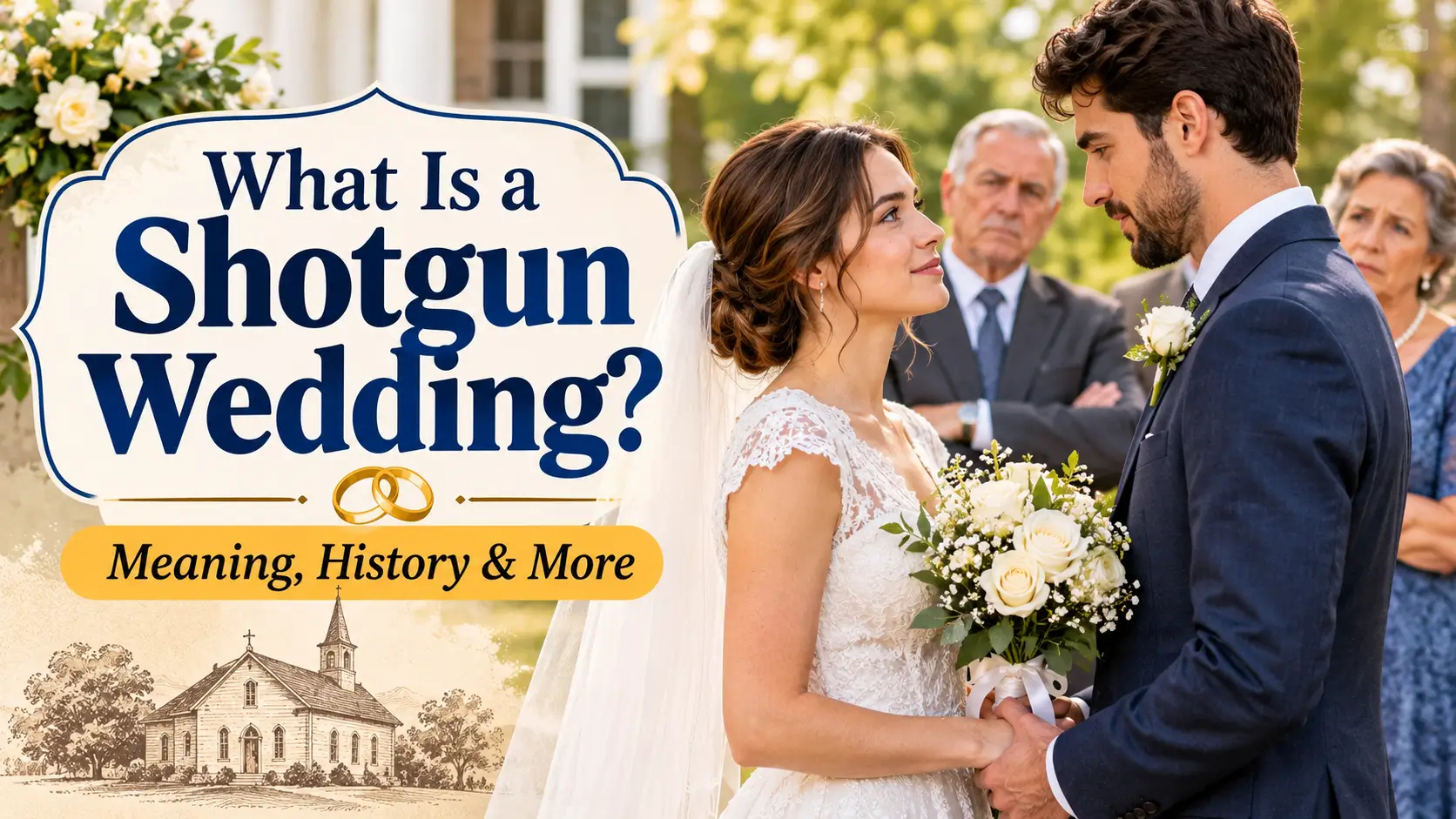
A shotgun wedding is an informal term for a wedding that happens quickly because the bride is pregnant, often due to family or social pressure.
Historically, the term suggested that the bride’s father might threaten the groom with a shotgun to make him marry her. Today, it can describe any marriage arranged under pressure rather than entirely by choice.
The expression has deep roots in American social history. Although it once reflected expectations about premarital pregnancy and family reputation, its meaning has evolved as attitudes toward relationships, marriage, and parenthood have changed.
What Does Shotgun Wedding Mean?
A shotgun wedding refers to a marriage that takes place because of an unexpected pregnancy or pressure from family members to marry before the baby arrives.
In traditional usage, the situation often involved:
- A couple having a pregnancy before marriage.
- The bride’s family wanting the couple to marry.
- A father or another relative pressuring the groom to propose.
- A wedding being arranged quickly to avoid social embarrassment.
- The couple marrying because they feel obligated rather than because they are ready.
Common usage: The expression does not necessarily mean someone literally uses a gun. It describes the pressure or circumstances surrounding the marriage.
For example, imagine a couple discovers they are expecting a baby. Their families insist that they should get married before the child is born. The couple agrees and plans a small ceremony within a few weeks.
Someone might describe their wedding as a shotgun wedding.
However, not every wedding involving an unexpected pregnancy is a shotgun wedding. If two people freely decide to marry because they love each other and want to build a family, the expression may not accurately describe their situation.
Where Did the Term Shotgun Wedding Originate?
The expression has American origins and is associated with social expectations surrounding pregnancy outside marriage during the 19th and early 20th centuries.
During earlier periods of American history, having a child outside marriage could bring significant social criticism, particularly for women. Families sometimes worried about their reputation, their daughter’s future, and the financial security of an expected child.
Marriage was often viewed as the socially acceptable response to an unexpected pregnancy.
Why Is It Called a Shotgun Wedding?
The name comes from the image of a father using a shotgun to pressure a reluctant young man into marrying his pregnant daughter.
In the familiar scenario, the father discovers that his daughter is pregnant and confronts the man responsible. He makes it clear that marriage is expected, with the implied threat of a shotgun if the man refuses.
The image became a memorable way to describe a marriage arranged under pressure.
Historical distinction: The expression reflects an idea of coercion, but it does not establish that fathers routinely used actual firearms to arrange marriages. The shotgun image became a powerful part of the phrase’s meaning.
When Did the Phrase First Appear?
The expression has been associated with American English since the 19th century.
Historical newspaper research has identified an early appearance of the phrase “shot gun wedding” in an 1878 Kansas newspaper. Another reference to a “double-barrel shot gun marriage” appeared in the same newspaper in 1879.
Major dictionary references, including Dictionary.com and Collins, date the established expression to the 1920s.
These dates reflect different types of evidence: early newspaper appearances and later dictionary recognition.
Why Were Shotgun Weddings Common in the Past?
Shotgun weddings were connected to social expectations about marriage, sexuality, parenthood, and family responsibility.
Several factors helped shape this practice.
1. Social Stigma Around Pregnancy Outside Marriage
In earlier American communities, premarital pregnancy could lead to gossip, criticism, and social exclusion.
Unmarried pregnant women sometimes faced greater judgment than the men involved. Families could feel pressure to arrange a wedding to protect their daughter’s reputation.
Marriage was often considered a way to make the situation socially acceptable.
2. Family Honor and Reputation
Family reputation carried considerable weight in many communities.
Parents sometimes worried about how relatives, neighbors, religious communities, and local society would respond to an unmarried daughter having a baby.
A wedding could be viewed as a way to restore family respectability.
These expectations varied by community, religion, location, and historical period. They were never universal.
3. Financial Security
Marriage was also connected to economic stability.
In periods when women had fewer independent financial opportunities, marriage could provide a more secure household for a mother and her child.
Some families believed that marrying the father was the best way to establish financial responsibility and provide a stable family structure.
4. Religious and Cultural Expectations
Some religious and traditional communities placed strong emphasis on having children within marriage.
An unexpected pregnancy could therefore create pressure to marry quickly.
However, religious communities did not all respond in the same way. Some emphasized marriage, while others offered support without requiring the couple to marry.
What Does a Shotgun Wedding Look Like Today?
The meaning of a shotgun wedding has changed over time.
In the United States today, an unexpected pregnancy does not automatically mean a couple must get married. Many couples choose to raise children together without marrying, while others decide to marry before or after their baby arrives.
A modern wedding following an unexpected pregnancy might look like:
- A courthouse wedding: The couple chooses a simple civil ceremony rather than a large traditional celebration.
- A small family ceremony: The couple invites close relatives and friends to celebrate their marriage.
- A quickly planned wedding: The partners arrange a ceremony within a few weeks or months.
- A postponed celebration: The couple legally marries privately and plans a larger wedding after the baby arrives.
- A completely voluntary marriage: Both partners decide that marriage is something they genuinely want.
These are examples of possible modern arrangements, not a separate wedding tradition with fixed rules.
Are Shotgun Weddings Still Happening?
Yes, marriages influenced by unexpected pregnancies and family pressure can still happen.
However, the traditional expectation that an unmarried couple must marry because they are expecting a baby is less widely accepted in many parts of American society.
Some couples still experience pressure from parents, relatives, or religious communities. Others make the decision independently because they want to marry and raise their child together.
The important distinction is consent. An unexpected pregnancy does not mean a couple has to marry.
Is a Shotgun Wedding the Same as a Traditional Wedding?
A shotgun wedding is not a particular wedding style or ceremony format. It describes the circumstances behind a marriage.
A couple could have a shotgun wedding in a courthouse, church, garden, backyard, or traditional wedding venue.
The ceremony itself might include all the usual elements:
- A wedding dress and suit.
- Wedding rings.
- A marriage officiant.
- Wedding vows.
- Family members and guests.
- A reception or small celebration.
The difference is the reason and circumstances surrounding the marriage.
| Feature | Traditional wedding | Shotgun wedding |
| Main reason | Personal commitment and desire to marry | Often an unexpected pregnancy or external pressure |
| Planning | Can take months or years | May happen quickly |
| Family involvement | Varies | Historically often involves family pressure |
| Ceremony | Any wedding format | Any wedding format |
| Consent | Both partners freely agree | May involve pressure or coercion |
A traditional wedding can also happen quickly, and a shotgun wedding does not always have to be small or inexpensive.
Does a Shotgun Wedding Mean the Groom Is Forced to Marry?
Not necessarily.
The expression traditionally suggests that the groom is being pressured by the bride’s family, particularly her father. However, modern usage can describe pressure from either family or from the circumstances surrounding an unexpected pregnancy.
There are important differences between family expectations and actual coercion.
For example:
- Family encouragement: Parents suggest that the couple consider marriage.
- Social pressure: Relatives make the couple feel embarrassed or judged for having a child outside marriage.
- Emotional pressure: One partner feels obligated to marry because of guilt or fear of disappointing family members.
- Threats or coercion: Someone uses intimidation, violence, or threats to force a person into marriage.
In the United States, pregnancy does not create a legal obligation to marry. Marriage requires voluntary consent, and state laws govern marriage requirements.
A person should not be threatened or forced into marriage because of pregnancy.
What Are the Pros and Cons of a Shotgun Wedding?
The phrase generally carries a negative association because it suggests that marriage may be happening under pressure.
However, the outcome depends on the couple’s actual circumstances, not simply on whether a pregnancy happened before the wedding.
Potential Benefits When the Decision Is Voluntary
- Shared commitment: Both partners may genuinely want to establish a married relationship.
- Family stability: The couple may want to build a shared household and plan their future together.
- Practical planning: Marriage can provide certain legal and financial rights, depending on applicable laws and circumstances.
- Family celebration: A wedding can give loved ones an opportunity to celebrate the couple’s commitment.
These benefits are not guaranteed by marriage itself.
Potential Challenges
- Limited preparation: The couple may have little time to plan their wedding or discuss married life.
- Financial pressure: Wedding expenses can add to the costs of preparing for a baby.
- Unresolved relationship issues: Rushing into marriage may leave important disagreements unaddressed.
- Family interference: Decisions may reflect relatives’ expectations instead of the couple’s wishes.
- Emotional stress: Pregnancy, wedding planning, and relationship changes can create additional pressure.
The most important consideration is whether both partners genuinely want to get married.
What Should Couples Consider Before Having a Shotgun Wedding?
An unexpected pregnancy can bring major life changes. Couples do not need to make every decision immediately.
Before deciding to marry, partners should have honest conversations about the following issues.
1. Do Both Partners Want Marriage?
The decision should come from both people.
A wedding should not be treated as a punishment, a family obligation, or a way to hide an unexpected pregnancy.
2. Are They Ready for the Responsibilities?
Marriage and parenthood involve different responsibilities.
Couples should discuss finances, living arrangements, childcare, employment, and their expectations for family life.
3. Are They Making the Decision Under Pressure?
Parents and relatives may have strong opinions, but the couple should have room to make their own decision.
If someone is facing threats, intimidation, or forced marriage, they should seek help from a trusted person or an appropriate support organization.
4. Would They Still Want to Marry Without the Pregnancy?
This is a useful question to discuss privately.
If both partners would still choose marriage without the unexpected pregnancy, that may help them understand their genuine feelings about the relationship.
If the answer is no, they can consider other ways to prepare for parenthood without rushing into marriage.
5. Have They Discussed the Legal and Financial Details?
In the United States, marriage can affect taxes, inheritance, property rights, insurance, and other legal matters.
The details depend on state law and individual circumstances. Couples should understand these responsibilities before making a decision.
What Should Guests Expect at a Shotgun Wedding?
If you receive an invitation to a wedding that someone describes as a shotgun wedding, the ceremony may look just like any other wedding.
It could be a courthouse ceremony, a small gathering at home, or a traditional celebration with a reception.
As a guest, remember that the circumstances surrounding the marriage may be personal.
A few simple etiquette guidelines can help:
- Congratulate the couple rather than questioning their decision.
- Avoid making jokes about pregnancy or the shotgun wedding label.
- Do not ask intrusive questions about the timing of the pregnancy.
- Follow the dress code and wedding invitation.
- Offer practical support if the couple needs it.
Etiquette tip: Unless the couple openly uses the term themselves, it is better not to describe their wedding as a shotgun wedding. The expression can sound judgmental or disrespectful.
Shotgun Wedding vs. Quick Wedding: What’s the Difference?
These expressions may sound similar, but they do not mean the same thing.
A quick wedding simply means a couple gets married with little time between the decision and the ceremony.
A shotgun wedding traditionally refers to a wedding influenced by an unexpected pregnancy or pressure to marry.
For example:
- A couple who decides to marry after dating for two months may have a quick wedding.
- A couple who gets married quickly because their families insist they marry after an unexpected pregnancy may have a shotgun wedding.
- A couple who discovers a pregnancy and independently decides to marry because they are ready may have a quick wedding, but the shotgun wedding label may not fit.
The distinction is that speed alone does not make a wedding a shotgun wedding.
Frequently Asked Questions
1. Does a shotgun wedding always happen because the bride is pregnant?
Traditionally, yes. The expression usually refers to a wedding prompted by an unexpected pregnancy. In broader modern usage, it can describe any marriage arranged under strong pressure or necessity.
2. Is a shotgun wedding legally binding in the United States?
Yes, if the marriage meets the applicable state requirements, including valid consent and proper licensing and solemnization. The circumstances of an unexpected pregnancy do not automatically invalidate a marriage.
3. Can a shotgun wedding be a happy marriage?
Yes. Some couples who marry after an unexpected pregnancy build loving, successful marriages. The outcome depends on their relationship, mutual commitment, communication, and individual circumstances.
4. Is a shotgun wedding always a small or courthouse wedding?
No. It can be a courthouse ceremony, a religious service, or a large traditional celebration. The term describes why the couple married, not the size or style of the wedding.
5. Is the term shotgun wedding offensive?
It can be. The expression may suggest an unwanted marriage, family pressure, or an embarrassing pregnancy. It is best to avoid using it to describe someone else’s wedding unless the couple is comfortable with the term.
Conclusion
A shotgun wedding is traditionally a marriage prompted by an unexpected pregnancy and pressure to marry quickly. Although the expression originated in older American social expectations, its meaning continues to evolve.
Today, couples can decide whether marriage is right for them without treating pregnancy as an obligation to wed. The best next step is to have an honest conversation about commitment, parenthood, and the future before making wedding plans.
