
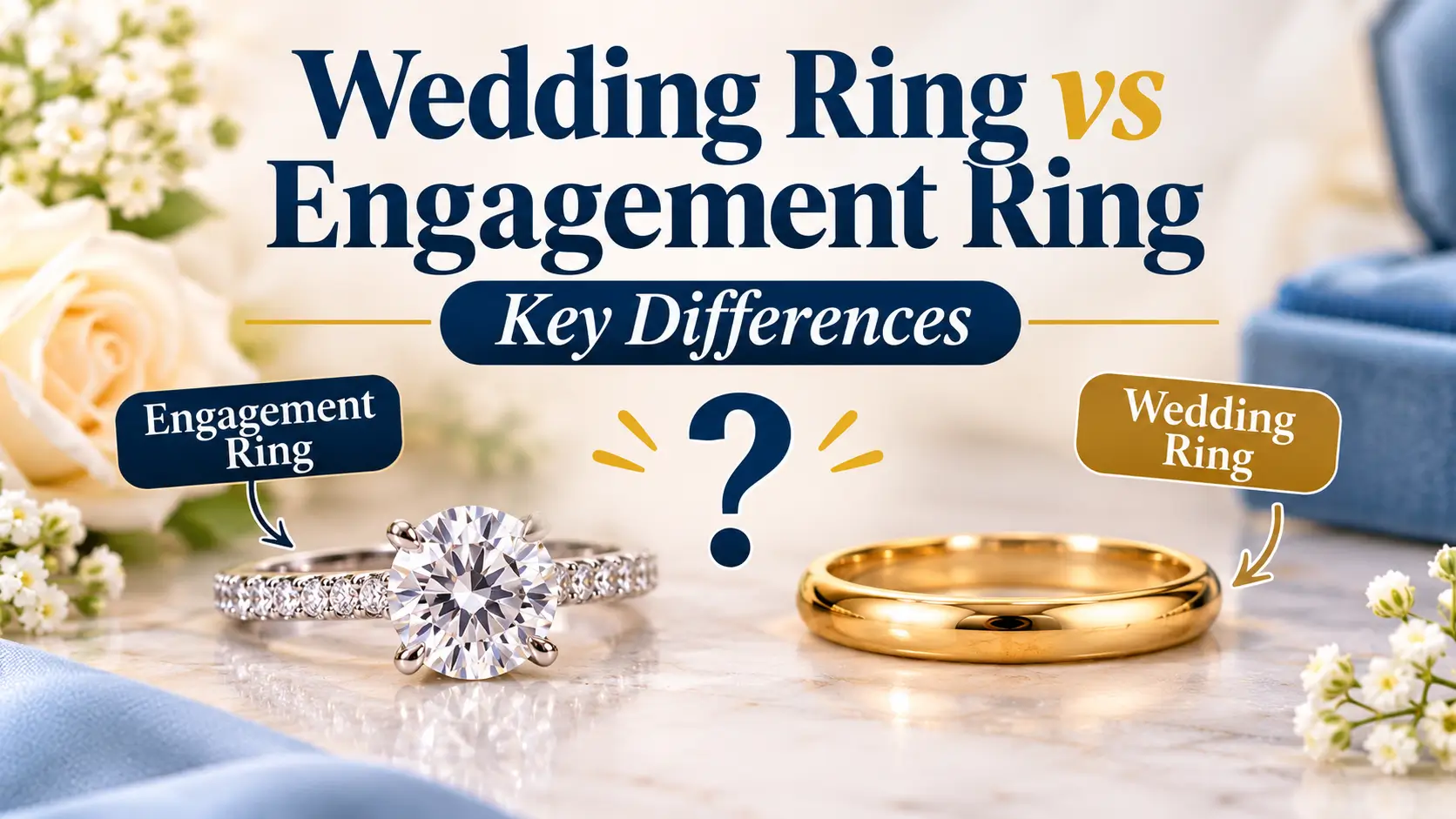
An engagement ring is given when someone proposes and signals a promise to marry.
A wedding ring (or wedding band) is exchanged during the ceremony and symbolizes the marriage itself. In the United States, both are traditionally worn on the left ring finger, with the wedding band closest to the heart.
Many couples buy both and wear them together, but they serve different moments and often look different. Knowing how each one works helps you budget, shop in the right order, and avoid fit problems later.
Wedding Ring vs Engagement Ring at a Glance
| Engagement ring | Wedding ring | |
| When given | At the proposal | At the ceremony |
| What it signals | A promise to marry | A marriage that has begun |
| Typical style | Often a center stone (a diamond is most common in the U.S.) | Often a plain or lightly detailed band |
| Who wears it | Traditionally the person being proposed to | Usually both partners |
| Worn after the wedding? | Yes, usually stacked with the band | Yes, daily |
| Who pays (U.S. custom) | The proposer | Each partner often buys the other’s, or each buys their own |
These are common practices, not rules. Plenty of couples skip an engagement ring, share the cost, or choose something other than a diamond.
What Is an Engagement Ring?
An engagement ring marks the decision to marry. It is a custom, not a legal requirement, and no U.S. law says you must have one.
The diamond solitaire became the dominant U.S. style over the 20th century, helped by heavy marketing from the diamond industry. Today you will also see sapphires, emeralds, moissanite, lab-grown diamonds, and vintage or antique settings. Whichever stone you choose, the setting needs to suit daily wear, because the ring will sit on your hand for years.
What Is a Wedding Ring?
A wedding ring is exchanged during the ceremony, often as part of the vows. In many Christian ceremonies in the U.S., the officiant leads the exchange.
Jewish ceremonies traditionally use a plain, unbroken band given by the groom to the bride under the chuppah, though modern ceremonies vary by community and often include a ring exchange in both directions. Practices differ in other faiths and cultures too.
Wedding bands are usually simpler than engagement rings. Classic options include plain gold, platinum, or titanium bands, plus styles set with small diamonds or gemstones. Because they are worn constantly, comfort and durability matter more than sparkle.
Which Hand and Finger in the United States?
Both rings are traditionally worn on the left hand, fourth finger. The wedding band usually sits closest to the hand, with the engagement ring stacked above it. This is the common U.S. practice, but customs differ elsewhere. In Germany and some other countries, for example, the ring is often worn on the right hand.
Some people move the engagement ring to the right hand during the ceremony so the band goes on first, then switch it back afterward. Others wear the engagement ring on top of the band from day one.
Do You Need Both?
No. Here are the common arrangements:
- Both rings: The traditional route. The engagement ring is worn from the proposal, and the band is added at the wedding.
- Engagement ring only: Some people wear just the engagement ring after the wedding, or have it serve as both.
- Wedding band only: Couples who skip the engagement ring often go straight to bands.
- Matching sets: Some jewelers sell an engagement ring and band designed to sit flush together, which solves the gap problem some stacked rings create.
How to Choose Rings That Work Together
Buy with the stack in mind. A tall or irregular engagement setting can leave a visible gap against a straight band. If you shop for the engagement ring first, bring it along when you choose the band.
A few practical points:
- Match metals when you can. Yellow gold against platinum will wear and look different over time.
- Think about your job and hobbies. High-set stones snag on gloves and catch on equipment.
- Allow for sizing changes. Fingers swell with heat, salt, and time of day, so get sized more than once if you can.
- Plan the order. Many couples keep the same jeweler for both so the two rings are made to sit together.
What About Cost?
Prices vary widely by metal, stone, brand, and whether you buy lab-grown or natural diamonds.
A reliable current figure for the U.S. should come from a recent industry survey, so check a source such as The Knot’s annual Jewelry and Engagement Study before setting a budget. As a general rule, wedding bands cost much less than engagement rings, since most lack a large center stone.
Before you buy, ask the jeweler:
- Is the stone certified, and by which lab?
- What is the return and resizing policy?
- Does insurance cover loss or damage, and what does the appraisal need to say?
- Can the band be made to fit the engagement ring’s shape?
Frequently Asked Questions
Can an engagement ring be used as a wedding ring?
Yes. Some people wear their engagement ring alone after the ceremony, and some couples buy one ring to serve both purposes.
Which comes first, the engagement ring or the wedding ring?
The engagement ring comes first, at the proposal. The wedding ring is exchanged later, at the ceremony.
Does the bride wear her ring on the wedding day?
Usually yes. Many brides wear the engagement ring from the proposal and add the band during the ceremony, or temporarily move the engagement ring to the right hand.
Do men wear engagement rings?
Traditionally no, but this is a custom, not a rule. Some couples exchange engagement rings both ways, and many men wear a wedding band.
Who pays for the wedding ring?
In U.S. custom, each partner often buys the other’s band, though many couples split costs or buy their own.
Conclusion
The wedding ring vs engagement ring question comes down to timing and meaning: one marks the promise, the other the marriage. Before you shop, decide whether you want one ring or two, then try the band and engagement ring on together at the jeweler so they sit well as a pair.

Emily Carter is a wedding planning writer and editor at MarryPlane. She covers wedding timelines, budgets, venues, invitations, vendors, ceremony planning, and practical details that help couples feel prepared for their big day. Emily focuses on clear, realistic advice that makes wedding planning easier without taking away from the excitement of the celebration.