
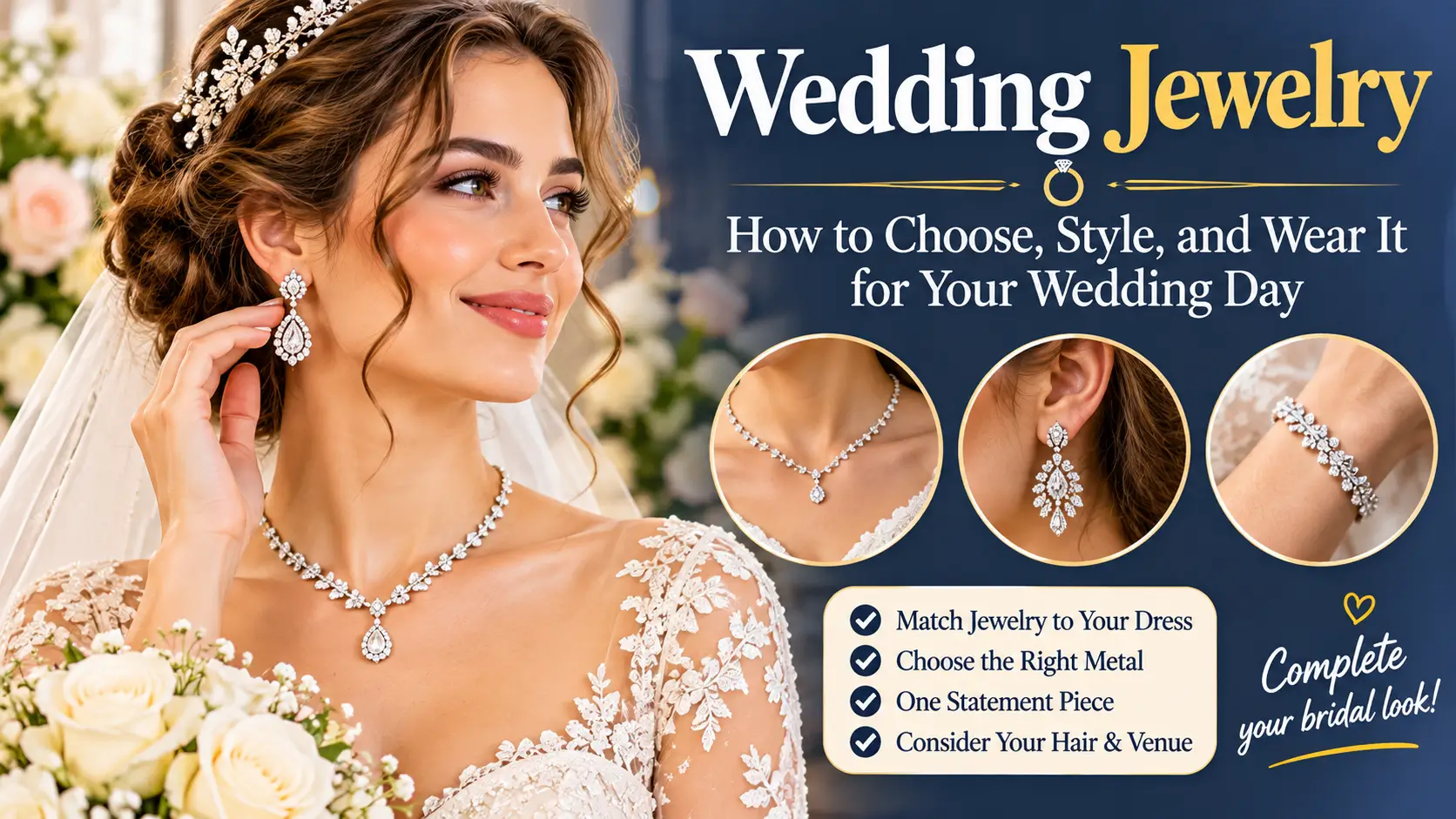
The short answer: The best wedding jewelry follows your neckline, then your hair, then your venue. Pick one focal point, either earrings or a necklace, and keep everything else quiet.
Match metal tones to your dress fabric (warm gold to ivory and champagne, silver or platinum to bright white). Choose pieces you can wear comfortably for 10 or more hours.
| Your neckline | Best focal piece | What to keep minimal |
| Strapless or sweetheart | Necklace (collar, pearl strand, or pendant) | Earrings (studs or small drops) |
| High neck, illusion, or lace collar | Earrings (chandeliers, sculptural drops) | Skip the necklace entirely |
| V-neck | Pendant that echoes the V | Small earrings |
| Off-the-shoulder | Statement earrings, or a short necklace if the neckline is wide and open | Bracelets |
| Halter or deep open back | Earrings, plus a back drop necklace if the back is open | Front necklace |
| Square or bateau | Earrings; a delicate chain only if it sits above the neckline | Chunky necklaces |
What counts as wedding jewelry?
Wedding jewelry covers everything worn to complete the wedding look: earrings, necklaces, bracelets, hair jewelry such as combs, pins, and vines, and sometimes brooches or body chains.
It sits alongside the engagement ring and wedding bands but is a separate decision. Rings are usually settled first, and the rest of the jewelry is chosen around the dress.
Jewelry is the last major styling decision, and it is often the one that makes a bridal look feel finished rather than merely dressed.
Start with the dress, not the jewelry
Your gown decides about 80% of your jewelry choices before you look at a single piece.
Neckline and structure. The neckline determines where the eye lands. A strapless gown leaves the collarbone open, so a necklace has room to work. A high lace collar or an illusion neckline already supplies detail at the neck. Adding a necklace creates clutter, and earrings are the better choice.
Fabric and embellishment. A heavily beaded or embroidered bodice needs restraint, such as simple studs or a clean cuff. A plain crepe or satin column dress can carry a more dramatic piece. A good rule is that the busier the dress, the quieter the jewelry.
Silhouette and drama. Structured, sculptural gowns pair well with clean-lined, geometric jewelry. Soft, flowing chiffon suits delicate chains and organic shapes such as petals and leaves. One current styling idea is to treat convertible gowns, with detachable sleeves, overskirts, or capes, as a cue for convertible jewelry. Interchangeable drop earrings and two-part ear jackets are suggested as pieces that can move from ceremony to reception.
Choosing metal and stone color
Warm and cool tones. Ivory, champagne, and blush fabrics tend to look richest with yellow or rose gold. Stark white and cool-toned silk look cleaner with white gold, platinum, or silver tones.
Mixing metals is fine. The old rule of matching every piece exactly has loosened. Mixed metals are listed among the leading wedding ring trends for 2026.
The mix looks intentional when one metal clearly dominates, for example gold earrings and necklace with a platinum engagement ring, and the secondary metal appears at least twice, so it reads as a choice rather than a mistake.
Diamonds, pearls, and color. Diamonds and white gemstones sparkle against any dress color. Pearls give a softer, creamier glow that suits lace and satin especially well. Colored stones, such as sapphire, emerald, or blush morganite, work best as a single accent. A small drop earring in a color that echoes your bouquet is an easy way to try it.
Earrings or necklace? Choose one star
The most reliable styling principle is one statement piece, everything else supporting.
- Statement earrings with a simple or no necklace: best for high necklines, updos, and slicked-back hair. Picture long chandelier earrings that frame the jaw.
- Statement necklace with small earrings: best for strapless and sweetheart gowns, and for hair worn down or in a low, soft style. Picture a graduated pearl collar with simple stud earrings.
- Delicate everything: a fine pendant, small studs, and a thin bracelet suit minimalist gowns, courthouse weddings, and brides who rarely wear jewelry.
Match jewelry to your hair and veil
Hair decides how much of your ears and neck the jewelry actually gets to show.
- Updo or low bun: exposes ears and neck, so this is the best setup for statement earrings or a choker.
- Hair down: covers earrings, so lean on a necklace, or choose earrings that sit above the hair line, such as ear climbers.
- Veil or headpiece: keep the hair accessory and the jewelry in the same finish and level of detail. A heavily jeweled comb with chandelier earrings competes with itself.
- Hats, capes, and headwear: Spring/Summer 2027 bridal runways showed unexpected headwear and capes used in place of veils. If you are going this route, keep jewelry simple so the headpiece stays the focal point.
Match jewelry to venue, season, and formality
- Black-tie or ballroom: longer drops, collar necklaces, and higher-sparkle stones suit the occasion.
- Garden or outdoor: lighter pieces in organic shapes. Heavy chandelier earrings can feel wrong on grass and in wind.
- Beach or destination: salt, humidity, and heat are hard on delicate chains. Choose secure clasps and avoid anything fragile or tarnish-prone.
- Courthouse or intimate ceremony: one refined piece, such as a pendant or a pair of pearl studs, usually looks better than a full set.
- Winter weddings: long sleeves and high necklines tend to push the focus to earrings and hair jewelry.
- Summer weddings: bare shoulders and collarbones can handle a necklace, but keep it light for comfort in the heat.
Comfort matters more than most brides expect
You will wear this jewelry through hugs, dancing, photos, and a very long day.
- Weight: heavy earrings can pull on earlobes within a few hours. If you love a large pair, consider swapping into lighter ones for the reception.
- Clasps: check that clasps are secure and easy to fasten without help, or ask someone to fasten them before the dress goes on.
- Allergies: if you have sensitive skin, confirm the metal before the wedding. Nickel is a common irritant, and solid gold, platinum, and hypoallergenic posts are safer.
- Do a test run: wear the full jewelry set with your hair trial or dress fitting, and move around in it.
Budget: where to spend and where to save
Wedding jewelry runs from borrowed family pieces to custom fine jewelry, and nothing says you must spend a lot.
- Spend on pieces you will wear again, such as pearl studs, a simple pendant, or tennis bracelets. Many current retailers pitch bridal jewelry as designed for repeat wear, including anniversaries and festive occasions.
- Save on hair accessories and one-time statement pieces, or consider renting them. Rentals are worth exploring for statement pieces you would not wear again.
- Consider alternatives such as heirloom pieces, vintage finds, or restyling inherited jewelry into something new. Another route is lab-grown stones. Rising gold prices and a push toward sustainability are cited as reasons couples are turning to lab-grown diamonds.
What’s current and what’s timeless
Trend reports on this topic come mainly from jewelers and jewelry retailers rather than independent fashion publications, so they reflect what is being sold as much as what is being worn. With that caveat, the same themes recur across the 2026 coverage:
- Personalization. Charms, initials, engraving, and fully custom designs are a recurring theme. Think birthstones, wedding dates, or heirloom elements built into a piece.
- Mixed metals and layering. Layered necklaces and mixed-metal combinations appear among the most popular bridal looks.
- Sculptural and geometric shapes. Flowing shapes, sculptural forms, and geometric accents are expected to stand out.
- Modern pearls. Pearls with a modern twist lead one retailer’s 2026 list, and pearl chokers are called out as a regal revival.
- Wearability after the day. Several sources describe an emphasis on longevity, with understated, architectural, and timeless pieces replacing one-day-only jewelry.
Classic pearl studs, a simple diamond pendant, and a clean tennis bracelet do not follow any trend cycle, so choose them if you want photos that will not look dated in 10 years.
Common mistakes to avoid
- Stacking a necklace on a detailed neckline. The jewelry fights the lace or beading.
- Wearing everything at once. Earrings, necklace, bracelet, ring stack, and hair jewelry together tend to look busy. Edit down.
- Forgetting how it photographs. Fine, thin pieces can disappear in photos, and very large ones can overpower the dress. Pieces with some sparkle and dimension tend to read well in images.
- Buying before the dress is final. Choose jewelry after you have the dress and a hair plan.
- Skipping the comfort test. A beautiful piece you remove by 7 p.m. is not a good choice.
- Ignoring the engagement ring. Wedding jewelry does not have to match the ring, but the two should not clash in metal or style.
Shopping considerations
- Check return and resizing policies before you buy, especially for necklaces, where length matters.
- Confirm metal purity, stone origin, and grading in writing for fine jewelry rather than relying on marketing language.
- Ask about secure backs on earrings, such as screw-backs or locking posts, if you plan to dance.
- For custom orders, allow plenty of lead time and ask for the estimated delivery date before paying.
Beyond the bride
Grooms, bridesmaids, and other members of the wedding party also wear wedding jewelry. For a groom, that usually means cufflinks, a watch, a tie bar, or lapel pins, with metals coordinated to the wedding bands.
For bridesmaids, matching earrings or a simple pendant in a shared metal tone ties the group together without requiring identical looks.
Visual direction for photos and images
For image opportunities, consider:
- A flat-lay of earrings, necklace, and hair piece on silk, with the dress fabric visible
- Close-ups of earrings against an updo, showing scale and movement
- Side-by-side comparisons of the same dress with a statement necklace and with statement earrings
- A detail of mixed-metal stacking on the hand, with the engagement ring and wedding band
Frequently Asked Questions
Should wedding jewelry match the engagement ring?
No, it does not need to match exactly. It should coordinate in metal tone and style, or contrast with it deliberately. Mixing metals is accepted, so long as one tone clearly leads.
Do I need a necklace if my dress has a high neckline?
Usually not. A high collar, lace neckline, or illusion panel already fills the space, so earrings and hair jewelry are the better focus.
How much jewelry is too much?
A good limit is one statement piece plus two or three quieter ones. If you cannot decide where the eye should land, remove a piece.
Can I wear colored gemstones to a wedding as the bride?
Yes. A single colored accent, such as sapphire earrings or an emerald pendant, is often chosen as “something blue” or to echo wedding colors. Keep the rest of the jewelry neutral.
Is real or fine jewelry necessary?
No. Quality costume jewelry, rented pieces, vintage finds, and family heirlooms are all valid choices. Fine jewelry is worth the investment mainly when you plan to wear it long after the wedding.
The takeaway
Pick the dress first, then choose a single focal point: a statement necklace for open necklines, or statement earrings for high or detailed ones.
Keep your metals coordinated (or deliberately mixed), and test the full look for comfort before the day. Choose pieces you would be happy to wear on your first anniversary, and the rest follows.
Emily Carter is a wedding planning writer and editor at MarryPlane. She covers wedding timelines, budgets, venues, invitations, vendors, ceremony planning, and practical details that help couples feel prepared for their big day. Emily focuses on clear, realistic advice that makes wedding planning easier without taking away from the excitement of the celebration.