
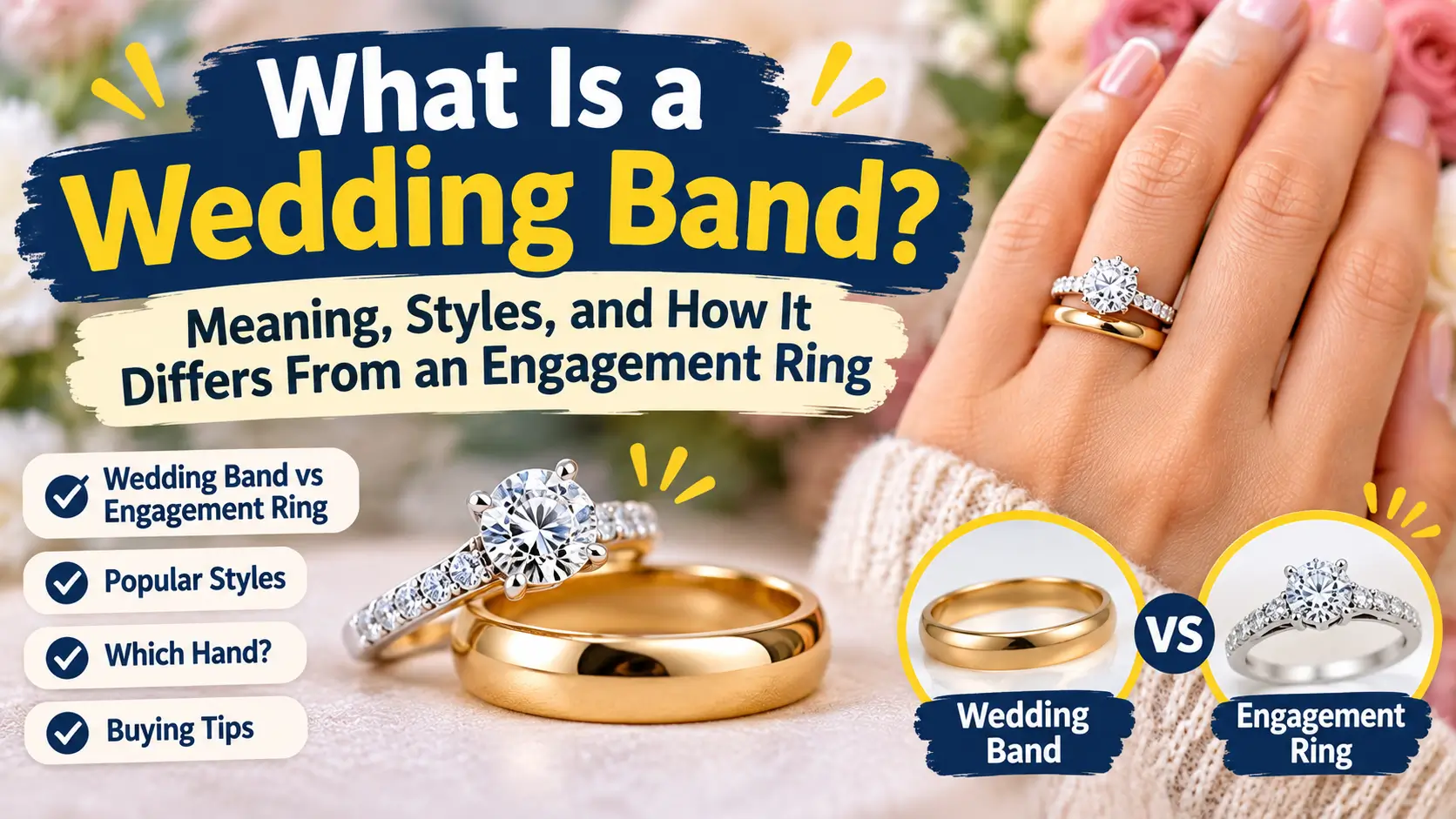
A wedding band is a ring that spouses exchange during their wedding ceremony to symbolize lasting commitment. It is usually a simple metal band worn on the ring finger. In the United States, it is most often worn on the left hand, either alone or paired with an engagement ring.
A wedding band is one of the few wedding items people wear every day for decades. That makes the details matter: what it is called, which hand it goes on, and what to look for when choosing one.
Wedding band vs. engagement ring vs. wedding ring
These terms overlap, which causes most of the confusion.
- Engagement ring: Given at the proposal, usually with a center stone. It signals a promise to marry.
- Wedding band: Exchanged at the ceremony. It is typically plainer, though many have diamonds or engraving.
- Wedding ring: A general term. It can mean the band alone or, in casual speech, the engagement ring and band together.
Many US couples wear both rings on the same finger, with the band closest to the hand. This is a common practice, not a rule. Some people move the engagement ring to the right hand, and others wear only a band.
Which hand does a wedding band go on?
In the United States, the common practice is the ring finger of the left hand. This custom varies by country and culture. Germany, Poland, and Russia traditionally favor the right hand, and some Orthodox Christian communities do as well. A Jewish ceremony traditionally places the ring on the bride’s right index finger, and she may move it afterward. Neither choice is wrong. Wear it where it feels right and fits your tradition.
Why the ring finger? A tradition, not a fact
Many sources trace the left ring finger custom to ancient Rome and Egypt, where people believed a vein ran directly from that finger to the heart. This belief is often called the vena amoris. Modern anatomy does not support it, so treat it as a tradition and a romantic story. The circle itself is the older, steadier symbol: it has no beginning or end, which stands for a marriage meant to last.
Rings made from reeds, leather, and metal appear in several ancient cultures. The exact origin of the modern wedding band is hard to pin to one place or date.
Common wedding band metals and styles
Most bands are sold in a few metals, each with trade-offs.
- Yellow, white, and rose gold: Classic and widely available. Lower karat (10K or 14K) is more durable than 18K, which is softer.
- Platinum: Dense, hypoallergenic, and naturally white. It develops a soft patina rather than losing metal as it wears.
- Palladium: A lighter platinum-group metal with a similar look.
- Titanium and tungsten: Popular for men’s bands and active lifestyles. They are hard to resize, and tungsten can crack under sharp impact.
- Silicone: A practical option for gym, work, or travel. Many people keep one as a backup.
Style matters too. A plain band has a flat or domed profile. A comfort-fit band has a rounded inner surface that slides over the knuckle more easily. An eternity band has stones around the full circle. An anniversary band is often given later and may be stacked with the original ring. Jewelers sometimes use these last two terms loosely, so confirm what you are buying.
Does the wedding band have to match the engagement ring?
No. Matching metals help the rings sit together without scratching or clashing, since gold and platinum wear differently. Beyond that, personal preference decides. Some couples choose matching bands for each other, and others choose entirely different styles. A curved or notched band can sit flush against an engagement ring if the settings are tall.
Practical tips before you buy
- Get sized at a jeweler. Fingers swell with heat, salt, and time of day, so measure more than once.
- Order early. Custom or resized bands can take several weeks. Ask for a delivery date in writing.
- Ask about resizing. Some metals and eternity bands cannot be resized easily.
- Check the warranty. Ask what free cleaning, sizing, and stone tightening are included.
- Plan the engraving. Dates, initials, or a short phrase go on the inside. Confirm the character limit.
- Insure the ring. Consider adding it to a renter’s, homeowner’s, or jewelry policy.
The other meaning: a wedding band as live music
In the music world, a wedding band is a group hired to perform at a reception, as opposed to a DJ. If you were looking for that, the same planning logic applies: ask about set length, song requests, equipment, and backup plans.
FAQ
Is a wedding band the same as a wedding ring?
Usually, yes. “Wedding ring” is the broader term, and “wedding band” often points to the plain, circular ring exchanged at the ceremony.
Do men wear wedding bands in the United States?
Many do, and it is a common practice in the US, though not required. Some people skip them because of their job, comfort, or personal preference.
Who buys the wedding bands?
There is no fixed rule in the US. Many couples buy their own, and others split the cost or buy for each other.
Can I wear a wedding band before the wedding?
Yes. Some couples wear them early as promise rings, though most wait until the ceremony exchange.
When do you take a wedding band off?
That is a personal decision. Some people remove it for sports, heavy work, or swimming to avoid damage or loss.
Conclusion
A wedding band is the ring that marks the marriage itself, and the details of metal, fit, and hand are all up to the couple and their traditions. Before you shop, get your ring size measured and decide whether you want a band that sits flush with an engagement ring, since that choice narrows the styles you will see.

Olivia Bennett is a wedding fashion and jewelry writer at MarryPlane, covering wedding dresses, guest attire, suits, shoes, veils, rings, and bridal accessories. She focuses on helping readers understand styles, materials, fit, and current wedding fashion while keeping her recommendations practical and timeless.