
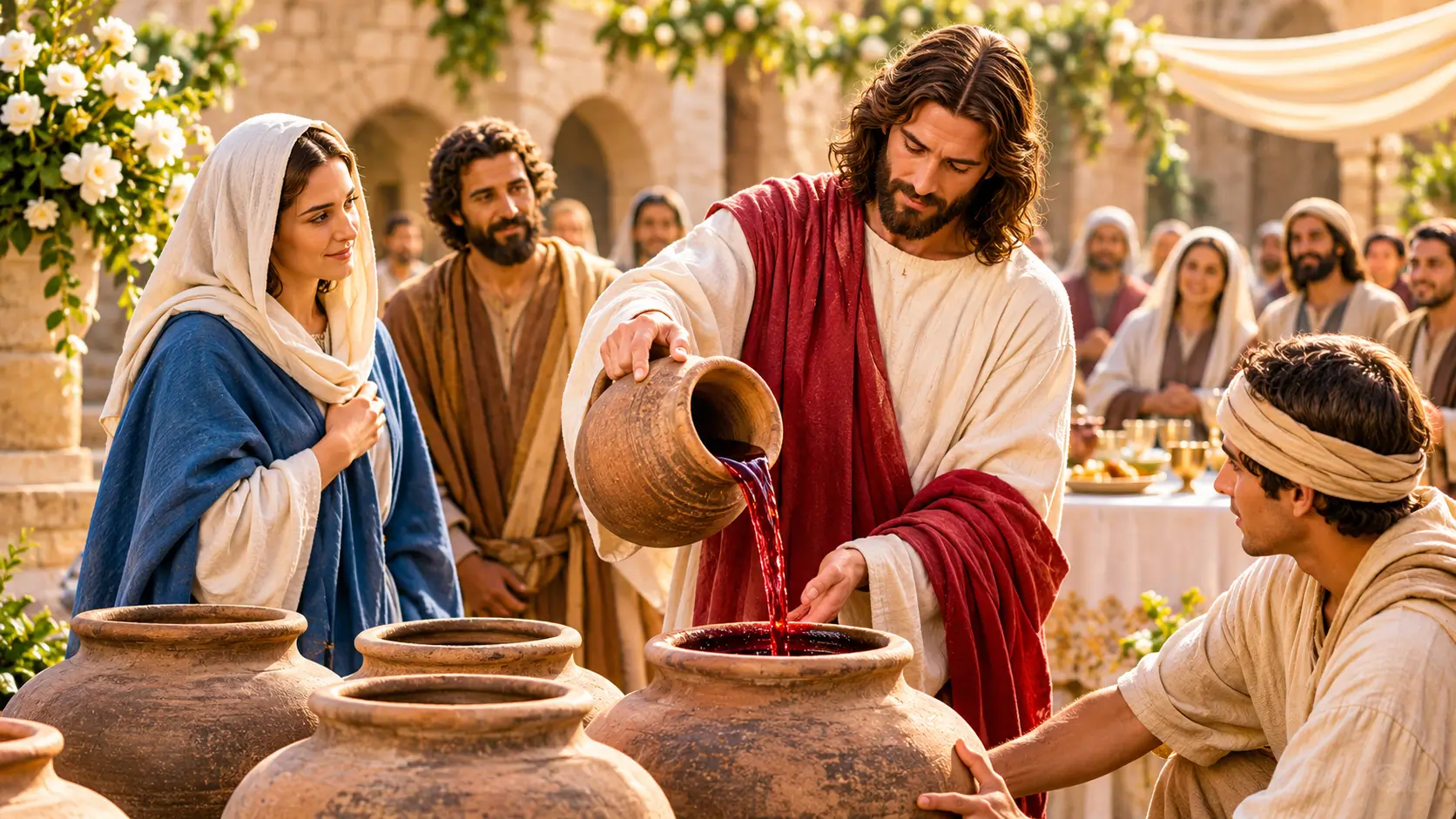
The Wedding at Cana is a biblical wedding described in John 2:1–11, where Jesus performed his first recorded miracle by turning water into wine. The event took place in Cana of Galilee, with Mary, Jesus, and his disciples attending. For Christians, the story represents faith, generosity, marriage, and God’s presence in everyday family life.
The Wedding at Cana holds a special place in Christian wedding traditions because it connects marriage with one of the most important moments in the ministry of Jesus. Its message continues to inspire couples who want their wedding celebration to reflect their faith.
What Is the Wedding at Cana?
The Wedding at Cana is an event recorded in the New Testament’s Gospel of John. It describes a wedding celebration where Jesus transformed water into wine after the hosts ran out of wine.
This miracle is commonly called the Miracle at Cana or the Wedding Feast at Cana. In Christian theology, it is also recognized as the first of the signs through which Jesus revealed his glory.
The story is especially meaningful for Christian couples because Jesus chose a wedding celebration as the setting for this first recorded sign. It connects marriage, hospitality, family life, and faith.
The Biblical Story of the Wedding at Cana
The complete account appears in John 2:1–11. Although the Gospel does not identify the bride and groom, it provides several important details about the celebration.
1. Jesus, Mary, and the disciples attend a wedding
The story begins with a wedding in Cana of Galilee. Mary, the mother of Jesus, is already present when Jesus and his disciples receive invitations.
Their attendance shows that Jesus participated in ordinary community and family celebrations. The wedding was an important social occasion, and his presence gives the event lasting significance in Christian teaching.
2. The wedding hosts run out of wine
During the celebration, the wine supply runs out. In the social setting of the story, this creates an embarrassing situation for the newly married couple and their families.
Mary notices the problem and brings it to Jesus’ attention. She simply tells him, “They have no wine” (John 2:3).
Jesus responds that his hour has not yet come. Mary then tells the servants to follow his instructions.
3. Mary gives the servants an important instruction
Mary’s words to the servants are among the best-known parts of this biblical account:
“Do whatever he tells you.” (John 2:5)
This instruction is important in Christian spirituality, particularly in Catholic teaching about Mary’s role.
It encourages believers to listen to Jesus and act according to his teachings. Mary does not perform the miracle herself. Instead, she directs the servants toward her son.
4. Jesus turns water into wine
Nearby, six large stone water jars are used for Jewish ceremonial purification. Jesus tells the servants to fill them with water.
They follow his instructions and fill the jars to the brim. He then tells them to draw some water and take it to the headwaiter.
When the headwaiter tastes it, the water has become wine.
The Gospel explains that the headwaiter does not know where the wine came from, although the servants who carried the water know what happened.
He calls the bridegroom and comments that the best wine has been saved until later in the celebration.
5. The miracle reveals Jesus’ glory
John 2:11 explains the significance of the event: Jesus performs his first sign at Cana, reveals his glory, and his disciples begin to believe in him.
This final detail makes the account more than a story about solving a wedding problem. It introduces Jesus’ public ministry and points toward his divine identity.
The biblical account does not name the couple or explain what happened to them after the celebration.
What Does the Wedding at Cana Mean?
The Wedding at Cana has several layers of meaning in Christian theology. Different Christian communities may emphasize particular aspects, but the following themes are widely recognized.
1. God’s blessing on marriage
Christian interpretation: Jesus’ presence at the wedding demonstrates that marriage and family celebrations have an important place in Christian life.
He does not avoid the celebration or treat it as unimportant. Instead, he participates in the gathering and responds to a need that arises.
For couples, this offers a meaningful reminder that faith can be part of everyday married life, not just religious ceremonies.
2. Love, generosity, and hospitality
Biblical context: The shortage of wine threatens the celebration’s hospitality.
By providing more wine, Jesus prevents the hosts from facing continued embarrassment and allows the celebration to continue.
Practical meaning: Couples can take inspiration from this story when planning their wedding. Hospitality is not measured only by expensive decorations, elaborate meals, or impressive venues. Making guests feel welcome matters more.
3. Faith and obedience
Mary’s instruction to the servants highlights the importance of trust and obedience.
The servants do not understand everything that is happening, but they follow Jesus’ directions.
For Christian couples, this can represent the importance of building a marriage around shared faith, patience, and a willingness to follow Christian values.
4. Transformation and new beginnings
The transformation of water into wine is often understood symbolically as a sign of spiritual transformation.
In Christian theology, it also points toward the new covenant established through Jesus.
For newlyweds, the symbolism offers another meaningful connection: marriage begins a new chapter in which two people build a shared life.
5. Joy and abundance
Wine was associated with celebration and joy in the biblical setting.
Jesus does not simply provide enough wine to finish the event. The headwaiter recognizes its quality and remarks that the best wine has been served later.
Pope Francis, in his June 8, 2016 general audience, explained the symbolism of the wine as an expression of the abundance and joy of the wedding feast.
Why Is the Wedding at Cana Important to Christian Couples?
The Wedding at Cana is especially meaningful for couples preparing for marriage because it connects a real human celebration with Christian faith.
Its lessons can help couples think beyond the wedding day itself.
Here are four important messages:
| Biblical theme | Meaning for married couples |
| Jesus attends the wedding | Invite faith into your marriage |
| Mary notices the problem | Pay attention to each other’s needs |
| The servants follow instructions | Practice trust and cooperation |
| Jesus provides the wine | Seek joy, generosity, and spiritual growth |
The story also reminds couples that marriage is not a promise of a problem-free life.
The wine running out represents an unexpected difficulty. The response to that difficulty shows the importance of seeking help, communicating, and facing challenges together.
For a Christian couple, prayer and faith can become part of that response.
The Wedding at Cana in Catholic Wedding Traditions
The Wedding at Cana has a particularly important place in Catholic teaching about marriage.
The Catholic Church views marriage between baptized Christians as a sacrament. Its celebration involves the couple’s consent, their lifelong commitment, and God’s grace.
The story of Cana helps express why Jesus’ presence matters in Christian marriage.
Can couples use the Wedding at Cana Bible reading at their wedding?
Yes. John 2:1–11 is used in Catholic marriage liturgies as a possible Gospel reading.
Couples planning a Catholic wedding in the United States can discuss this reading with their priest or parish wedding coordinator. The available readings and liturgical choices should follow the applicable marriage rite and parish guidance.
It can be particularly appropriate for couples who want their ceremony to emphasize:
- Jesus’ presence in marriage.
- The importance of faith and prayer.
- Mary’s example of trust.
- The joy of celebrating a new family.
- God’s blessing throughout married life.
Is there a Catholic blessing connected to Cana?
Catholic marriage liturgies include prayers and blessings that recognize Jesus’ presence at the wedding in Cana.
The USCCB also shares Pope Francis’ teaching that the Lord’s presence gives Christian wedding celebrations their deeper meaning.
However, couples should not assume that every Catholic wedding includes a separate Cana ceremony. The biblical reading, prayers, and blessings are part of the Church’s liturgical framework, not a requirement to recreate the miracle.
How Different Christian Traditions Understand the Wedding at Cana
The Wedding at Cana appears in the Gospel of John, so Christians across several denominations recognize its importance.
However, interpretations and the way the passage is used in worship can differ.
| Christian tradition | Common emphasis |
| Roman Catholic | Mary’s intercession, Jesus’ first sign, marriage, and sacramental meaning |
| Eastern Orthodox | Christ’s divine glory, the blessing of creation, and the transformation of water into wine |
| Protestant | Faith in Jesus, his first miracle, obedience, and the importance of Christian marriage |
| Anglican | Christ’s presence at marriage, biblical teaching, and the meaning of Christian commitment |
These are broad descriptions, not rules followed identically by every church.
Some Protestant churches regularly use the passage in wedding services, while others select different biblical readings. Catholic and Orthodox communities also have their own liturgical practices.
The shared message is that Jesus’ first recorded sign took place during a wedding celebration.
Where Did the Wedding at Cana Take Place?
According to John 2:1, the wedding took place in Cana of Galilee, a location in the historical region of Galilee.
Its precise historical location remains debated.
Two commonly discussed sites are:
- Kafr Kanna: A town near Nazareth in modern-day Israel. It has a long-standing Christian pilgrimage tradition connecting it with the biblical Cana.
- Khirbet Qana: An archaeological site farther north that some researchers have proposed as the location of ancient Cana.
Archaeological research has also examined Karm er-Ras, near Kafr Kanna, as a possible identification of the ancient settlement. These competing proposals mean that the exact location cannot be stated with certainty.
Can couples visit Cana today?
Christian pilgrims can visit Kafr Kanna, where churches commemorate the biblical wedding.
The Church of the Wedding is associated with the tradition of Jesus’ first miracle. Visitors often come to pray, reflect on marriage, and celebrate wedding anniversaries.
Some couples also choose to include Cana in a religious pilgrimage connected with their marriage.
Travelers should check current local conditions, access arrangements, and travel guidance before planning a visit.
How to Include the Wedding at Cana in a Modern Wedding
Couples who want a faith-centered celebration can incorporate the story without turning their wedding into a reenactment of the biblical event.
Here are some meaningful ideas.
1. Choose John 2:1–11 as a wedding reading
Ask your minister or priest whether the passage can be included in your ceremony.
It is especially suitable for couples who want their guests to understand the connection between Christian faith and marriage.
2. Include a prayer for your marriage
A family member, pastor, or priest may offer a prayer asking God to guide the couple through happiness, uncertainty, and difficult seasons.
The prayer can reflect the themes of Cana, including generosity, faith, and joy.
3. Use Cana-inspired wedding decorations
Subtle decorative details can reference the story:
- Wine-colored flowers or table accents.
- Olive branches and greenery.
- Stone-inspired decorative pieces.
- Bible verses displayed near the guest book.
- Elegant glassware representing the wedding feast.
These are modern design ideas, not historical requirements.
4. Add a meaningful wedding gift
A Bible featuring John 2:1–11, a personalized scripture print, or a framed wedding prayer can make a thoughtful gift for Christian newlyweds.
The most meaningful gifts are those that reflect the couple’s beliefs and the kind of marriage they hope to build.
5. Celebrate wedding anniversaries with the Cana story
Couples can revisit the passage during an anniversary dinner or prayer service.
It offers an opportunity to reflect on the joy of marriage, the challenges overcome, and the importance of keeping faith at the center of family life.
What the Wedding at Cana Means for Wedding Guests
The story also offers a meaningful perspective for people attending a Christian wedding.
Guests can take away several lessons:
- Celebrate marriage: A wedding is an occasion to support and encourage the newly married couple.
- Practice hospitality: Make other guests feel welcome and included.
- Respect the couple’s faith: Understand that religious readings and prayers are meaningful parts of their celebration.
- Value relationships: The people surrounding a couple can provide encouragement throughout married life.
The central message is not about hosting an expensive reception. It is about celebrating love, community, faith, and the beginning of a new family.
Frequently Asked Questions
1. What happened at the Wedding at Cana in the Bible?
Jesus attended a wedding with Mary and his disciples. When the hosts ran out of wine, Jesus instructed servants to fill six stone jars with water, which he miraculously turned into wine.
2. Was the Wedding at Cana Jesus’ first miracle?
Yes. John 2:11 identifies it as Jesus’ first sign, through which he revealed his glory and strengthened his disciples’ belief.
3. Who got married at Cana?
The Bible does not identify the bride or groom. Their names and identities are not provided in the Gospel of John.
4. Why is the Wedding at Cana important for marriage?
It shows Jesus participating in a wedding celebration and helping the hosts during a difficult moment. Christians interpret this as a reminder of God’s presence, generosity, and blessing in married life.
5. Can I use John 2:1–11 at my wedding?
Yes. The passage is an option in Catholic marriage liturgies and may also be selected by couples in other Christian traditions, depending on their church’s practices.
Conclusion
The Wedding at Cana remains an important biblical story about faith, marriage, generosity, and God’s presence in family life. Its message offers Christian couples a meaningful foundation for building a marriage rooted in love and trust. Couples planning a faith-centered wedding can consider John 2:1–11 as a ceremony reading and discuss its significance with their minister or priest.

Daniel Morgan is a writer and editor specializing in wedding traditions, cultural celebrations, vows, gifts, food, music, and the stories behind modern wedding customs. At MarryPlane, he explores how couples around the world celebrate marriage while explaining traditions in a respectful, accessible way for modern readers.