
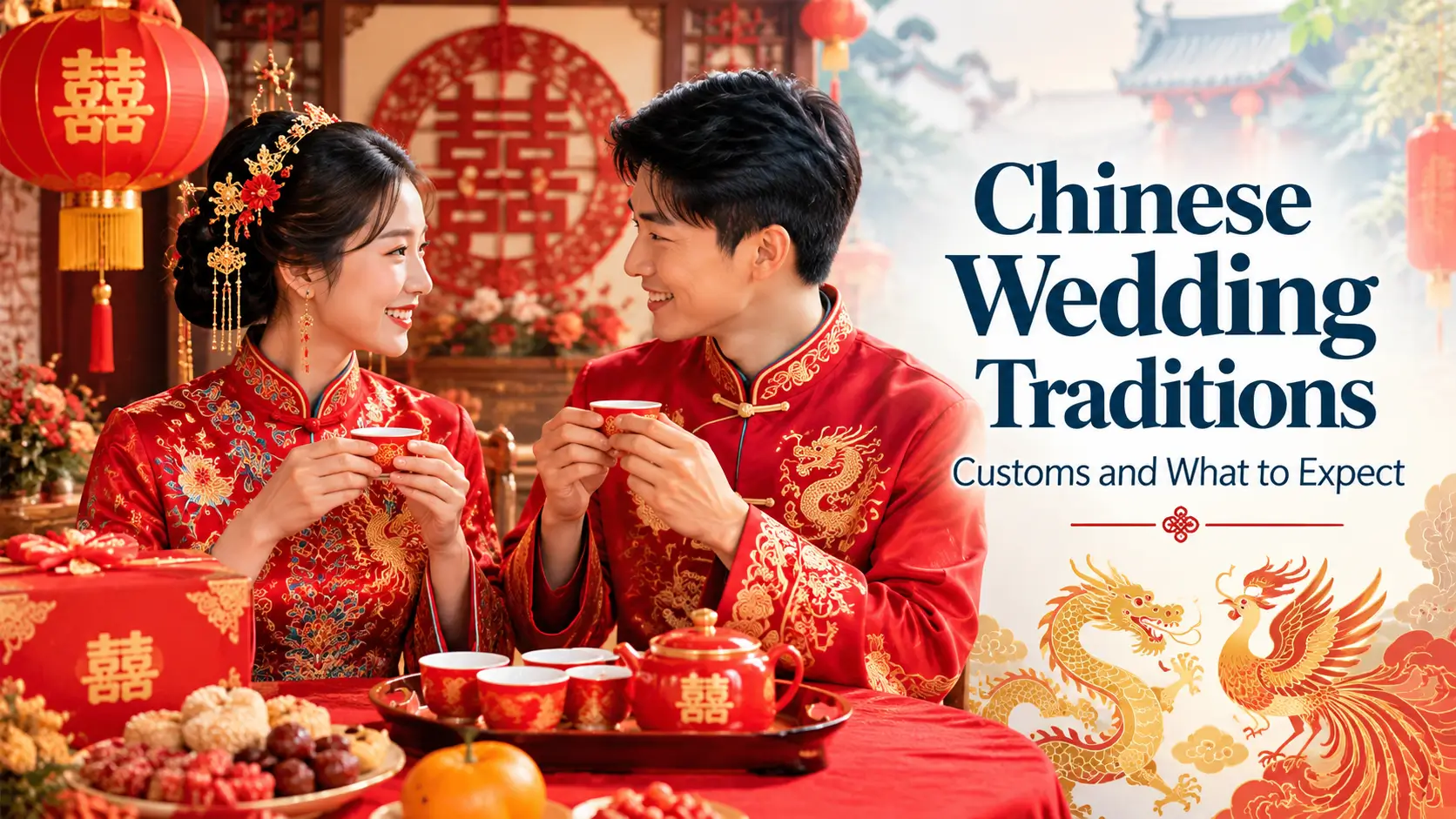
A Chinese wedding is a family-centered celebration built around red decorations, a tea ceremony honoring elders, symbolic gifts, and a multi-course banquet.
Customs vary by region and family, but the shared themes are luck, respect, and joining two families. In the United States, couples often pair these traditions with a legal ceremony.
No single script exists for a Chinese wedding. A Cantonese family in San Francisco, a Taiwanese family in Houston, and a Shanghainese family in New York may each do things differently, and many couples now blend customs with a Western ceremony. Below you’ll find where the traditions come from, how the day usually unfolds, and what couples and guests should know.
Where Chinese Wedding Traditions Come From
Many customs trace back to classical ritual texts, including the Yili (Etiquette and Ceremonial), which describes a sequence known as the Six Rites. This is the historical framework behind marriage in imperial China:
- Nacai: the groom’s family sends a go-between to propose.
- Wenming: the families exchange the bride’s name and birth details.
- Naji: the match is checked through divination to confirm it is auspicious.
- Nazheng: the groom’s family presents betrothal gifts.
- Qingqi: the wedding date is chosen.
- Qinying: the groom goes in person to bring the bride home.
Few families follow all six steps today, and the matchmaker has largely disappeared. The outline survives, though. Families agree formally, gifts change hands, a lucky date is picked, and the groom’s side comes to collect the bride. Underneath it all is a long-standing view that marriage joins two families as well as two people, which is why parents and grandparents often have a real say.
Symbols and Their Meanings
Chinese wedding decor, clothing, and food rely on symbols that many families treat as essential. The table separates what is a firm tradition from what is a common practice.
| Symbol | Meaning | Type |
| Red | Luck, joy, protection from misfortune | Tradition, widespread |
| Double Happiness (囍) | Joy doubled for the couple | Tradition, widespread |
| Dragon and phoenix | Groom and bride; balance and harmony | Tradition, especially Cantonese |
| Number 8 | Prosperity; the sound resembles “wealth” in Mandarin and Cantonese | Common practice |
| Number 9 | Longevity; the sound resembles “long-lasting” | Common practice |
| Number 4 | Avoided; the sound resembles “death” | Common practice |
| Red dates, lotus seeds, longan | Fertility and sweetness, often served in wedding tea | Tradition, varies by family |
| White and black | Linked with mourning, so often avoided in guest attire | Common practice |
Before the Wedding Day
Choosing the date. Many families consult a Chinese almanac or a fortune teller who works from the couple’s birth dates.
Dates containing an 8 are popular, and many families avoid the seventh lunar month, known as Ghost Month. Not every family does this, and some couples simply pick the most convenient Saturday.
Betrothal gifts. In the custom called guo da li, the groom’s family presents gifts to the bride’s family. These commonly include pastries or cakes, tea, fruit, paired items such as dragon and phoenix candles, and sometimes jewelry or money.
The bride’s family typically returns part of the gifts. Some families also exchange a cai li (often translated as bride price), while others skip it entirely, so treat it as a family decision rather than a rule.
Hair combing. In some families, especially Cantonese ones, the bride’s hair is combed the night before by an older woman known for a happy, long marriage and living children. The ritual marks the move into married life and is accompanied by spoken blessings.
How a Chinese Wedding Works Step by Step
The order below reflects a typical modern day, such as a Cantonese-American or Mandarin-speaking family might hold. Your own timeline may differ.
The Groom’s Arrival and Door Games
On the morning of the wedding, the groom and his party travel to the bride’s home or hotel suite. The bridesmaids block the door, and the groom must earn entry through “door games.” These are playful challenges, such as answering questions about the bride, eating something sour or spicy, or paying with red envelopes. It is meant to be lighthearted, and the red envelopes are a way of showing generosity to the bride’s side.
The Tea Ceremony
The tea ceremony is the part most families consider non-negotiable. The couple kneel or bow and serve tea to the elders in order of seniority, usually starting with the groom’s parents in many families, though the order varies.
Each elder drinks and gives the couple a red envelope, and often gold or jade jewelry, along with a blessing.
Afterward, younger relatives often serve tea to the couple and receive red envelopes in return.
The ceremony shows respect for the older generation and formally welcomes the new spouse into each family. It is usually held privately with relatives, often in the morning, at one or both family homes.
The Wedding Ceremony
Chinese-American couples commonly hold a separate ceremony before the banquet. It might be Western-style with vows, a religious service, or a civil ceremony.
Traditional Chinese weddings were centered on bowing to Heaven and Earth, to the parents, and to each other, and some couples include a version of that today. Brides often wear a white gown for this portion and change into red later.
The Banquet
The evening banquet is the centerpiece for most families. It usually has eight or ten courses, and menus often include whole fish for abundance, lobster or chicken paired for the dragon and phoenix theme, noodles for long life, and a sweet soup such as red bean or lotus seed at the end.
Shark fin soup, once a banquet staple, is now left off by many couples for environmental and ethical reasons, and some US states ban its sale.
The bride often changes outfits several times, sometimes wearing a red qipao or a Cantonese qun kwa embroidered with gold dragons and phoenixes.
The couple then visits each table to toast guests, who respond with “gan bei” in Mandarin or “yam seng” in Cantonese. A lion dance sometimes opens the celebration.
Chinese Weddings in the United States Today
Most Chinese-American weddings are hybrids. A typical day might include a morning tea ceremony, an afternoon Western ceremony, and an evening banquet with several outfit changes. Couples choose which traditions carry meaning for their families and drop the rest.
Several modern trends have also shaped the day. Many couples schedule a professional photo shoot weeks before the wedding, a practice popular in Taiwan and Hong Kong.
Others hold the banquet at a Chinese restaurant for the food, then add a separate cocktail hour for guests unfamiliar with the customs. Same-sex couples adapt the customs too, often reshaping roles and outfits so both partners are honored.
A good planner or venue coordinator who understands the tea ceremony, banquet pacing, and outfit changes can save a lot of stress.
Regional and Family Variation
China is large, and the diaspora even more so, so no single version of a Chinese wedding is the “authentic” one.
- Cantonese families often emphasize hair combing, the qun kwa, door games, the lion dance, and a long tea ceremony with gold jewelry gifts.
- Hokkien and Teochew families have their own customs around gifts, ancestor offerings, and tea, which differ in detail.
- Taiwanese families often combine Chinese customs with local practices, including elaborate pre-wedding photography and banquet traditions.
- Northern and Shanghainese families may hold smaller tea ceremonies, different menus, and different gift customs.
- Christian and Buddhist families often add a church service or temple blessing, and may drop customs they see as superstition.
Mainland China, Hong Kong, Taiwan, and overseas communities have all adapted traditions differently, and many families simplified or changed them in the past century. Ask the families involved what they actually do rather than assuming.
What to Expect as a Guest
- Bring a red envelope. Cash in a red envelope is the standard gift in many Chinese communities. Even amounts are preferred, and amounts containing a 4 are avoided. How much to give varies by region, your closeness to the couple, and the venue, so ask a friend from the same circle if you’re unsure.
- Dress festively. Avoid all-white and all-black outfits. Many guests also skip head-to-toe red, since red is the bride’s color. Smart, colorful clothing is a safe choice.
- Check the timing. Banquets sometimes start later than the printed time, but arrive on time for any ceremony.
- Tell the hosts about dietary needs early. Banquet menus are set in advance and served family-style, so last-minute changes are hard.
- Join the toasts. When the couple reaches your table, stand, raise your glass, and say “gan bei” or “yam seng.”
- Expect photos. Large family portraits can take time, and guests are sometimes pulled in.
Tips for Planning a Chinese Wedding
Start with a conversation with parents and grandparents. Ask which customs matter most to them and why, then decide together which two or three belong in your day. Confirm the date against any family beliefs early, since banquet venues book far in advance.
Ask venues about table counts, set menus, and whether they allow outside lion dancers or a tea ceremony space. Finally, print a short program for guests who haven’t attended a Chinese wedding, explaining the tea ceremony and banquet toasts.
FAQ
Yes. Many Chinese-American brides wear a white gown for the ceremony and change into red for the tea ceremony or banquet. White is traditionally linked with mourning, but modern Western influence has made it widely accepted.
The tea ceremony and banquet are cultural celebrations and have no legal effect on their own. You still need a marriage license from your local authority and a legally recognized officiant, and requirements vary by state.
It often fills a full day. The tea ceremony and photos usually happen in the morning or afternoon, and the banquet runs for several hours in the evening.
Traditionally, the groom’s family covered betrothal gifts and much of the banquet, while the bride’s family prepared a dowry. Today, costs are commonly shared between the families and the couple, and arrangements vary widely.
Yes, and many families welcome it. Taking part in the tea ceremony, learning the basic toasts, and asking the family which customs matter most are good places to start.
Conclusion
A Chinese wedding is less about following a rigid checklist and more about honoring family, luck, and continuity in the way your families understand them. Before you book vendors, sit down with the elders and agree on the two or three customs that matter most, then build the day around them.

Daniel Morgan is a writer and editor specializing in wedding traditions, cultural celebrations, vows, gifts, food, music, and the stories behind modern wedding customs. At MarryPlane, he explores how couples around the world celebrate marriage while explaining traditions in a respectful, accessible way for modern readers.